


By Mario Galeana
For Luis Ricardo, drawing is an obsession. For drawing, he has finished a stream of notebooks in the last twenty years and says that, if he could, every page would go to absolute black. One stroke upon stroke to the edge of the intelligible. He’s even drawing right now, as we speak on the phone.
“When I draw, I somehow reflect a mood or what I’m feeling or thinking at that moment. And right now I’m drawing myself while thinking about your question,” he says.
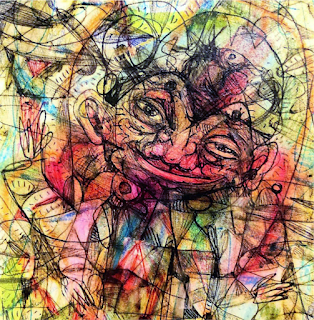 |
| Drawing by Luis Ricardo, photo by Mario Galeana |
Luis Ricardo’s drawings are a juxtaposition of characters, ideas, and eyes. Strokes that find their form in the chaos. Beings that contain multitudes, self-portraits, and maps of thought. A psychedelic air, limpid despite its overcrowding. An expression of the impulse and of the now.
That is why María Eugenia Jiménez Melo, curator of Reglas para una lluvia de ideas (Rules for a brainstorming session), Luis Ricardo’s most recent exhibition, says that his drawings are “here and now”, or “an experience of unanswered questions”. They are not sketches, he is not planning anything, nor looking to imitate the image of something around him.
“They are landing drawings (…) He is an obsessive draftsman, a bit out of the norm, who draws to concentrate; he has an attention disorder and since he remembers he needs to do something so as not to escape from what is there and must be attended to,” he explains in a curatorial text that accompanies the exhibition.
Reglas para una lluvia de ideas gather dozens-if, not hundreds-of some of the drawings Luis Ricardo has made since 2003 until this year. The exhibition was inaugurated on October 7 at the Sergio Pitol hall of the Casa de Cultura in Puebla, where it remained until mid-November.

THE LINE AND THE STORY
When the exhibition was proposed, however, she had certain doubts: her drawings were just that, strokes and strokes in a pile of notebooks; they had no signature, no chronological order, they were not framed and many were small, smaller than half a sheet of paper.
“But Maru (María Eugenia Jiménez) came up with the idea of pasting them against the wall, of pasting many drawings, and it was a great idea. Because I don’t set out to make a work of art; I rather have drawings because the notebook accompanies me everywhere.”
Perhaps the nature of Luis Ricardo’s work explains why, over a 20-year career as an illustrator, he has had only four exhibitions so far.
The first was presented at the end of 2016, at Lilliput Gallery, and was titled Lo nuevo es lo olvidado. There, he included drawings in pen, pencil, digital color, and watercolor, as well as a guitar intervened with pen ten years earlier.
The second was inaugurated in mid-2017 at the Alliance Française. Por debajo del agua, as he named it, reflected his facet in painting, video, animation, and collage. And perhaps this is the most direct antecedent to the work in NFT that he would develop years later.
The third was exhibited in mid-2019 at the Teatro de la Ciudad, and he named it Notables: comics about Puebla. There he presented his work as a cartoonist, which until then had been exhibited only on his own site and in the news portals Lado B and La Jornada de Oriente.
The fourth has been, finally, Reglas para una lluvia de ideas, the compilation of his most personal work.
THE LINE AND THE EYES
In contrast to the loose drawings placed uniformly on the walls of the hall, Luis Ricardo’s most recent exhibition created an idea of continuity. Like glimpsing the diary of a person whose language is not mainly encoded in words, but in strokes, in the succession of ink on paper.
And in that successive count of the days, there were conceptual maps as well as ideas, quotes, notes, and eyes, especially eyes.
Curator María Eugenia Jiménez believes that this may be the result of her training as a filmmaker. “Maybe that’s why the eyes of his characters are the only thing that remains precise in the midst of a chaos of lines. And, more than eyes, the look. The expressions of his characters are the ones that are realizing something and that makes them so interesting,” he proposes.
Luis Ricardo considers that the myriad of eyes that populate his drawings is perhaps due to the fact that it was one of the first things he learned to draw, before cinema and his training as a teacher and before all the other things when he was just a high school student.
“Eyes seem very important to me. In 2010, my psychiatrist told me something about the gaze, he said that people who have depression often draw characters who are not looking straight ahead. That interested me a lot because I was depressed at the time. From then on, I thought it was important for the eyes of my characters to see us,” he explains.
 |
| The Wallpaper |
The exhibition Rules for a brainstorming session was complemented by a wallpaper that Luis Ricardo drew in situ, which from a distance gave the impression of being a codex or a cartographic work in which the characters are strung from tongue to sphincter.
The room included the projection of three pieces of digital art, the path that Luis Ricardo has found in recent years. In the NFT market, the artist observes some advantages compared to traditional or analog art.
“I’ve never liked the medium or the artistic community, I’ve never been interested in selling in the two or three galleries that exist and, until this event, I wasn’t interested in exhibiting either. In the digital world I feel more comfortable, it’s much more impersonal and, to a certain extent, anonymous,” he says.


